You Can’t Protect What You Can’t See
If you ask a security professional what keeps them up at night, it usually isn't the vulnerabilities they know about—it's the ones hiding on servers they didn't even know existed.
In Vulnerability Management (VM), the golden rule is simple: you cannot secure what you do not know exists. When asset inventories are incomplete, security teams fail to scan and assess all their systems, leaving untracked vulnerabilities that attackers can easily exploit. Unmanaged assets like legacy systems, forgotten test servers, and abandoned cloud instances become prime entry points for lateral movement.
To build a strategic VM program, you have to move away from static spreadsheets and manual tracking. Here is how to build a modern, automated asset management strategy.
The Challenge: Expanding Attack Surfaces
Today’s attack surface is massive and constantly shifting. It includes:
• Traditional IT: On-premises servers, desktops, and network gear.
• Cloud & SaaS: Virtual machines, containers, serverless functions, and cloud storage (e.g., S3 buckets) that may only live for seconds or minutes.
• IoT & OT: Smart devices and industrial control systems that often lack standard security management.
• External-Facing & Shadow IT: Websites, APIs, and unauthorized services spun up by employees without security oversight.
Because cloud workloads scale dynamically and new assets are introduced daily, periodic scans and static inventories are completely obsolete.
The Automation Strategy: Connecting the Ecosystem
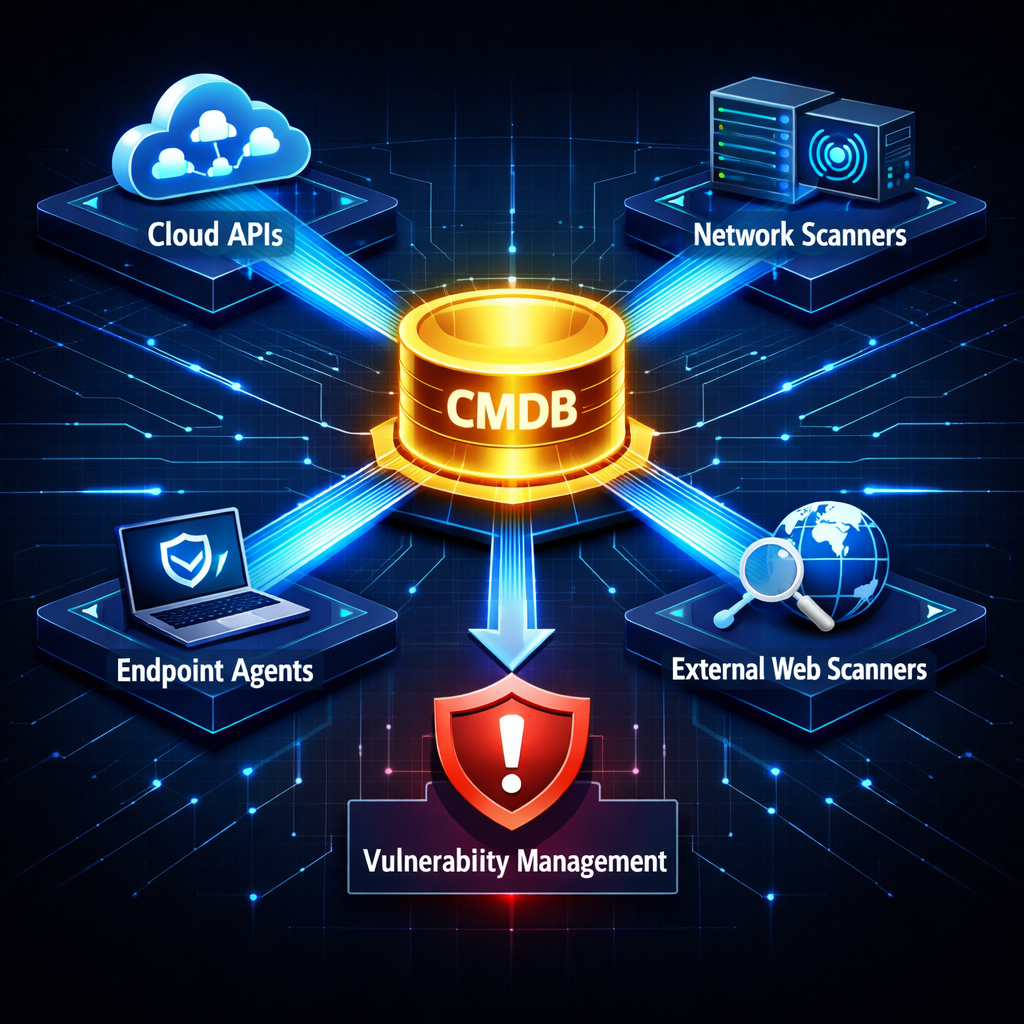
To effectively manage this sprawl, organizations must automate their asset tracking and integrate their discovery tools directly with their VM platforms. Because no single tool can cover on-premises, cloud, SaaS, and external assets, you must integrate multiple tools to achieve full coverage.
Here is a 4-step automation strategy to achieve continuous visibility:
1. Deploy Domain-Specific Discovery Tools Instead of relying on one massive scanner, use specialized tools to automatically discover assets in their native environments:
• EASM (External Attack Surface Management): Continuously scans for publicly exposed assets, identifying shadow IT, forgotten subdomains, and misconfigured cloud services.
• Cloud Asset Management (APIs): Use native tools like AWS Config or Azure Resource Graph to dynamically track ephemeral cloud workloads, containers, and serverless functions via API.
• Network Scanners: Deploy tools like Nessus or Qualys to scan internal networks for active devices, open ports, and unmanaged rogue systems.
• EDR/XDR: Leverage endpoint agents (like CrowdStrike or Microsoft Defender) to detect endpoints and monitor connected devices across the enterprise.
2. Automate Asset Correlation into a CMDB Use a Configuration Management Database (CMDB), such as ServiceNow, to act as your centralized "single source of truth". Automate the ingestion of data from all your discovery tools into the CMDB using APIs, which reduces manual errors and ensures assets are consistently tracked.
3. Apply Metadata and Classification Raw IP addresses are useless without business context. Automate the tagging of assets with crucial metadata, such as business unit ownership, data sensitivity (e.g., PII), and exposure level (internal vs. public-facing). This classification is what allows you to distinguish between an unpatched testing server and a critical revenue-generating database.
4. Feed the VM Engine Finally, automate the sync between your CMDB and your VM scanning tools. This ensures that the moment a new asset is discovered and classified, it is automatically included in the correct vulnerability scanning schedules and prioritized based on its true business risk.
Conclusion
Asset management is no longer an administrative IT chore; it is the absolute foundation of security. By integrating your discovery tools, automating correlation, and ensuring clear asset ownership, you eliminate the blind spots that attackers love to exploit. Without a complete, real-time inventory, your vulnerability scanners are only telling you half the story.