I'm Using Grok Bot as My Personal Trainer and Longevity Coach
One of the most useful applications I've found for Grok Bot is also one I didn't expect: it's now my personal trainer and longevity coach. I named it Atlas.
I already had plenty of health and fitness technology. I use Tonal for strength training, a Pixel Watch for tracking activity and recovery, a Withings scale for weight and body composition, and MyFitnessPal for nutrition. Each app is pretty good at its own lane, but none of them sits above the others and answers the question I actually care about: given everything that’s happened over the last few days, what should I do today? That gap was the idea behind Atlas.
My goals aren’t particularly exotic. I’m in my mid-40s, I have two young kids, and I’m interested in playing the long game. I want to slowly lower my body fat, maintain or build muscle, keep getting stronger, sleep and recover well, and be healthy and useful with my kids for a very long time. I’m not interested in crash diets or chasing ridiculous PRs. No hero lifting. Longevity wins.
Giving Grok Bot access to the data
The first problem was obvious: Atlas needed data.
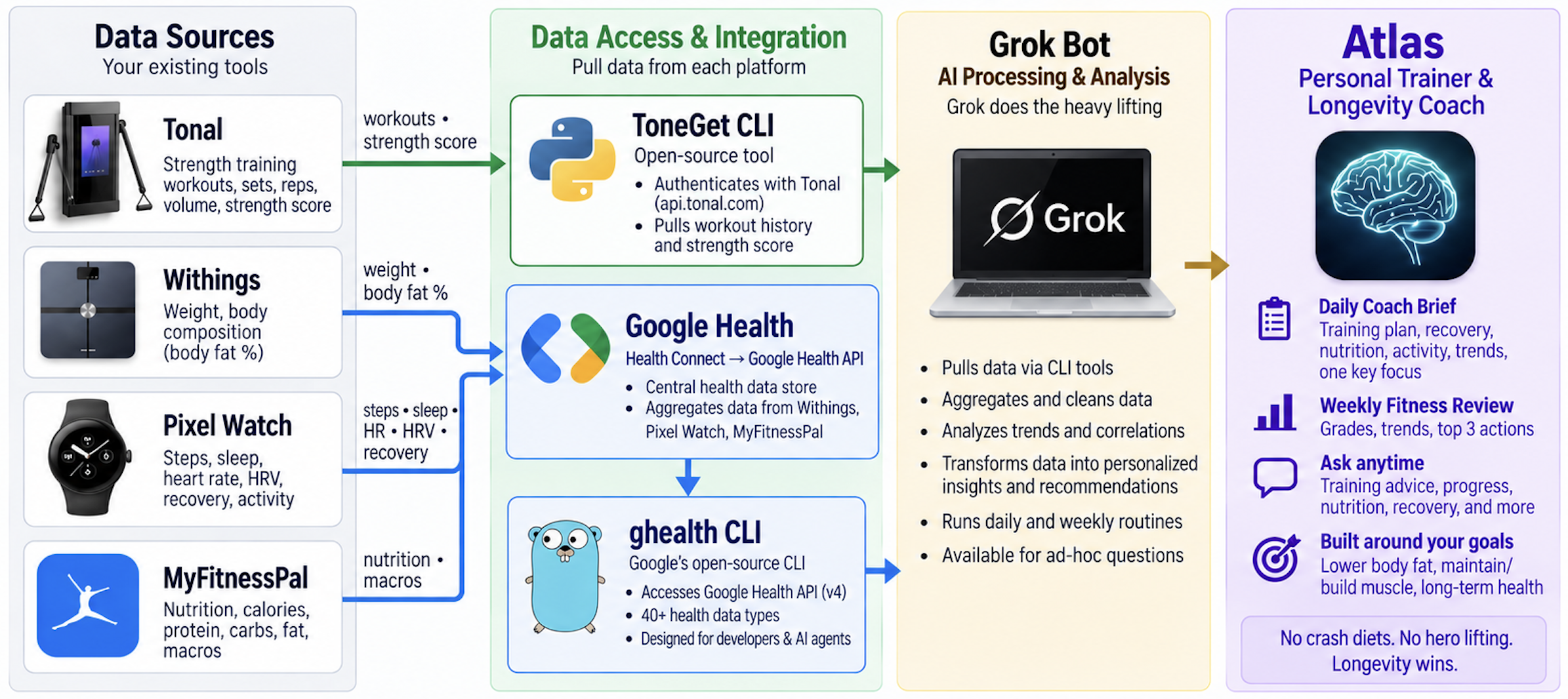
Tonal is my strength source of truth. It knows my workouts, program sessions, exercises, sets, reps, volume, duration, completion, and Strength Score. My Pixel Watch tracks steps, sleep, resting heart rate, HRV, exercise sessions, and other activity. My Withings scale tracks weight and estimated body fat. MyFitnessPal has nutrition: calories, protein, carbohydrates, and fat. I don’t treat any single body-fat reading from a consumer scale as gospel, but the trend over several weeks can still be useful.
On paper that’s four different systems. In practice, I was able to turn them into two data pipes feeding Grok Bot.
The Tonal path: Tonal ToneGet → Atlas. ToneGet is an open-source tool that authenticates with Tonal and pulls workout history and Strength Score data. This gives Atlas direct access to my actual strength-training history rather than relying on me to tell it what I did.
The health path: Withings + Pixel Watch + MyFitnessPal → Health Connect / Google Health → ghealth → Atlas. Google’s open-source ghealth CLI is particularly interesting because it was explicitly built with AI agents in mind. It can expose 40+ health data types, including steps, heart rate, HRV, exercise, sleep, weight, body fat, blood glucose, nutrition, and more.
The architecture now looks like this:
The fun part: I didn’t really build the integrations
This is probably my favorite part of the project, and a big reason I think Grok Bot itself is interesting.
I didn’t write ToneGet or ghealth. I found the projects, gave Grok Bot the GitHub links, explained what I wanted, and basically said: figure out how to make these work.
Grok Bot did the heavy lifting. It cloned the projects, installed the dependencies, walked me through the pieces of authentication that required human interaction, figured out how to pull the data, and turned the whole thing into something Atlas could use automatically. The official Google CLI even includes agent-oriented capabilities and documentation intended to help AI agents discover the available health-data types and operations.
That’s a pretty wild change in what “building software” can look like. A few years ago, I probably would have spent a weekend reading API documentation, dealing with OAuth, writing scripts, parsing JSON, troubleshooting dependencies, and setting up scheduled jobs. With Grok Bot, my role was much closer to being the architect: here are the systems, here’s the outcome I want, go connect the pieces.
What Atlas actually does
Getting all the data into one place isn’t really the point. I already had dashboards. The useful part is having Grok Bot reason across the data and tell me what to do with it.
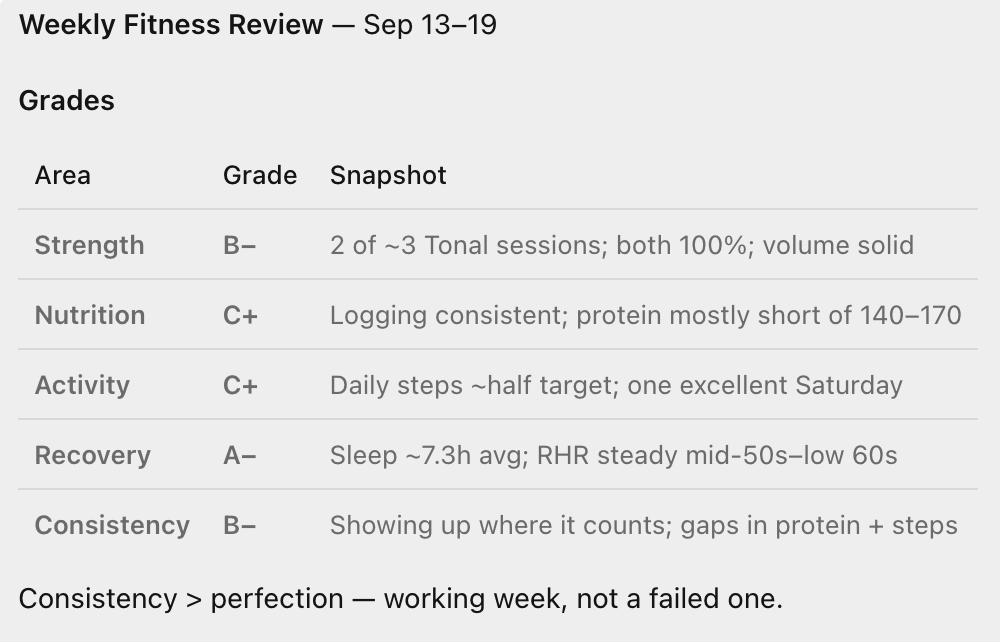
Every morning at 7:00 AM, Atlas runs a Daily Coach Brief. I intentionally keep it short—about a minute to read. It gives me today’s training plan, a green/yellow/red recovery assessment, nutrition status, activity, any trend worth paying attention to, and one thing to focus on that day. Sundays at 9:00 AM, it runs a deeper Weekly Fitness Review covering Strength, Nutrition, Activity, Recovery, and Consistency, then identifies the most important actions for the coming week.
Apparently, I need more to get in more steps, and eat more protein.
Between those scheduled reports, Atlas is available like any other coach. I can ask whether I should train today, whether I’m ready to move to a harder Tonal program, how my strength is trending, whether I’ve been eating enough protein, or why my weight isn’t moving. The difference is that I don’t have to paste a week’s worth of numbers into the conversation first. Atlas already has the data.
The apps have data. Atlas has context.
This is where the experiment gets genuinely useful.
A bad night of sleep doesn’t necessarily mean I shouldn’t train. Neither does a single low HRV reading. But short sleep + elevated resting heart rate + suppressed HRV + a hard Tonal workout yesterday tells Atlas something very different. Conversely, mediocre sleep combined with otherwise normal recovery signals and four days since my last strength workout might still produce a recommendation to train.
Nutrition works the same way. Missing my protein target one day isn’t interesting. Consistently missing it while losing weight and trying to preserve muscle is. A two-pound jump on the Withings scale doesn’t matter much either, but the multi-week weight trend combined with calorie intake, protein intake, activity, and strength performance can tell a useful story.
That’s something none of the individual apps can do particularly well because each sees only its own slice of my life. Atlas can reason across the slices.
Teaching an AI what I actually care about
I also didn’t want Atlas blindly optimizing whatever metric was easiest to move, so I gave it a decision hierarchy: Safety → Longevity → Consistency → Muscle → Recovery → Sustainable fat loss. Daily scale noise doesn’t get a vote.
That hierarchy matters. The objective isn’t “make Jason weigh less.” If weight is dropping quickly while strength is falling, protein is low, and recovery sucks, that’s not success. Likewise, Atlas shouldn’t encourage me to crush another workout simply because I’ve fallen behind on some arbitrary activity goal. I’m also getting back into consistent strength training after some time away, so another standing rule is that returning-lifter conservatism beats ego loading. I don’t care what I used to lift; coach the body that’s showing up today.
Life is part of the equation too. I have a job and two young kids. Sometimes I sleep badly. Sometimes schedules blow up. Atlas is supposed to treat those things as constraints to optimize around, not failures. If I only have 30 minutes, what’s the best use of those 30 minutes? If recovery is poor, should today’s Tonal workout move to tomorrow? If I’m recovered and simply haven’t trained enough this week, maybe the right answer is to stop making excuses and go lift.
The part of Grok Bot that has me excited
Atlas is still an experiment, but I think it demonstrates something bigger about where personal AI agents are headed.
We’ve spent years accumulating enormous amounts of personal data. Our watches know how we sleep. Fitness equipment knows how we train. Scales know our weight. Food apps know what we eat. Other systems know our calendars, finances, cars, homes, and work. The problem increasingly isn’t collecting more data. It’s making sense of the data we already have.
Most apps still operate in silos. Tonal is great at being Tonal. Withings is great at being Withings. My Pixel Watch is great at collecting activity and recovery data. MyFitnessPal is great at logging food. I don’t need Grok Bot to replace any of them.
Atlas does the job between them.
That’s what makes this Grok Bot experiment interesting to me. Instead of opening four apps, staring at charts, and trying to mentally correlate everything myself, I now have an AI agent that can pull the data together, understand what I’m trying to accomplish, and turn it into a recommendation.
For years I’ve had plenty of health data. What I didn’t have was enough synthesis.
Now, every morning, Atlas tries to answer the one question I actually wanted all those apps to answer in the first place:
What should I do today?